Matter Machine
Technologies
Get in touch
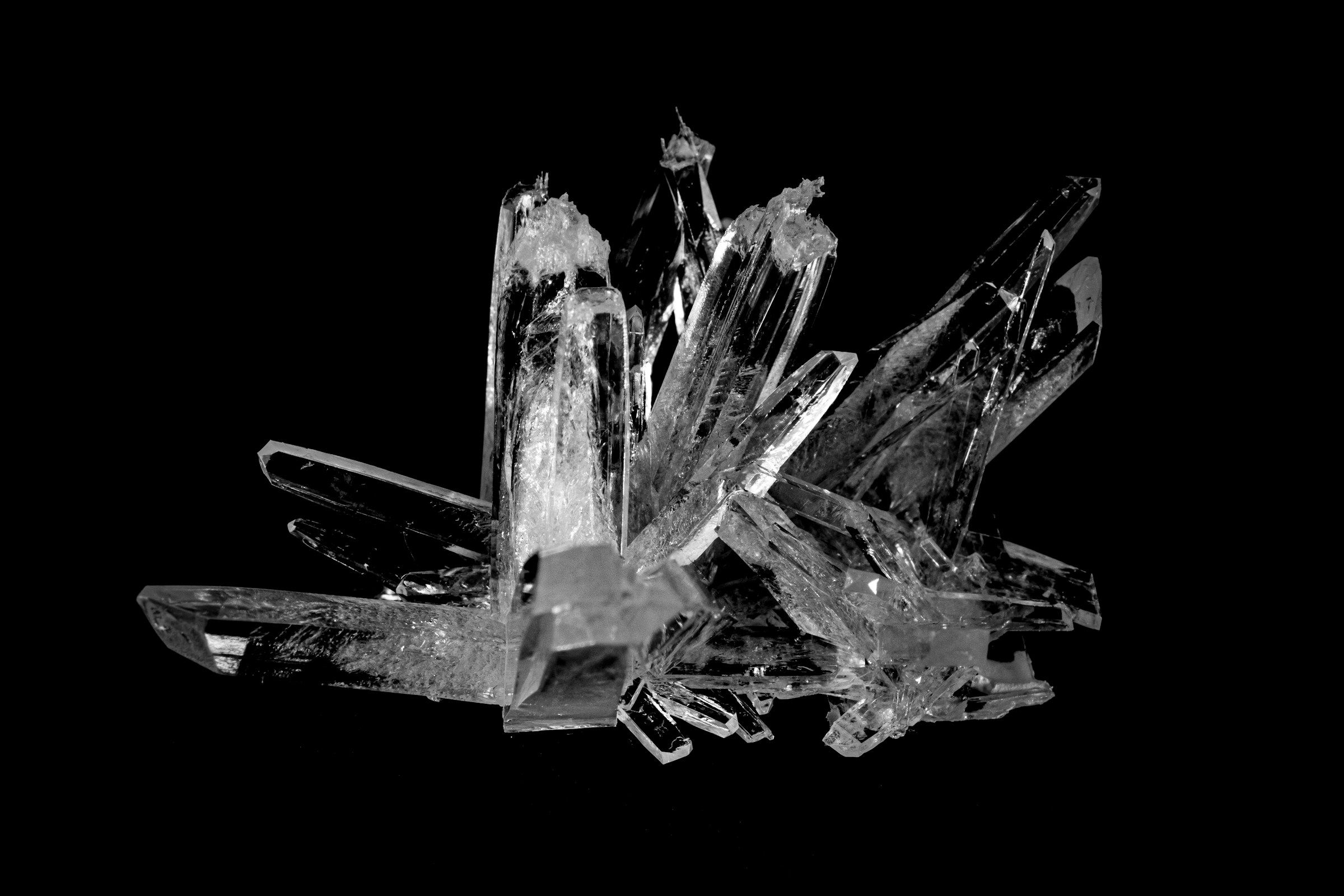
Close-up of clear crystals growing outwards against a black background

New inorganic materials, proven in the lab.

* A University of Liverpool spinout. We connect deep synthesis and characterisation expertise with AI and physics-guided prediction, then prove every candidate in the laboratory.
See how a discovery cycle works

A predicted candidate is a starting point, not a finished discovery.

The grand challenge of inorganic materials discovery is the chasm between AI-guided prediction and synthesis: the prediction to synthesis gap. Many tools can propose structures. Far fewer can make them, measure them and say what they really do.

Matter Machine comes from the other end of the discovery spectrum. It starts from more than twenty years of experimental synthesis and characterisation at the University of Liverpool, and uses that expertise to aim AI where it counts: at materials that can be made.

One discovery cycle

An iterative process connected by expert judgement. Choose a stage, or let the cycle run: each measurement informs what is tried next.

Define

Informed by the key scientific objectives and expert judgement. Deep chemical understanding frames the direction of the work and guides how AI and physics-based tools are used.

Illustration of the published Define, Select, Synthesize, Measure workflow. Atoms and structures shown are schematic, not Matter Machine results. Automation supports the workflow where it is scientifically useful, rather than replacing every human decision.

One integrated platform

Four complementary capabilities brought together in one place, rather than a standalone software product.

Experimental materials chemistry

Synthesis, structure determination and property measurement connect chemical composition with the arrangement of atoms and the functions a material can deliver. Laboratory evidence is central to discovery.

Workflow Engineering™ and automation

Highly engineered workflows, laboratory automation and high-throughput assays support faster experimentation. Automation is applied to the scientific question, not assumed for every step.

Foundational scientific understanding

Knowledge across diverse chemistries guides which questions to ask, how to read results and what to try next, linking each discovery to wider composition, structure and property relationships.

Proprietary AI, data and physics-based computation

Curated proprietary databases, bespoke machine learning and automated reasoning help navigate chemical possibilities, alongside physics-grounded computation that steers synthesis campaigns.

Built on two decades of discovery

Accounts of Chemical Research · 2025

Discovery of Crystalline Inorganic Solids in the Digital Age

Summarising two decades of work at the University of Liverpool, the paper describes discovering new crystalline inorganic solids through computational support combined with experimental validation, with expert human assessment central to judging true novelty. The Matter Machine tech stack is built on this digital-to-lab workflow.

Read the paper
Lithium electrolyteLi7Si2S7I

The case study in the paper: a solid lithium-ion conductor found with computational guidance and made in the lab.

Thermal insulatorBi4O4SeCl2

A layered material reported in Science (2021) with very low thermal conductivity along its stacking direction.

Atrium of the Materials Innovation Factory at the University of Liverpool
Materials Innovation FactoryUniversity of Liverpool. Both compounds come from academic research, not Matter Machine products.

The people behind the machine

Portrait of Professor Matthew Rosseinsky

Prof Matthew Rosseinsky OBE FRS

Founder & Director

Chair of Inorganic Chemistry at the University of Liverpool. Combines digital tools, machine learning and automation with experimental synthesis. Royal Medal of the Royal Society, 2025.

Portrait of Dr Gordon Sanghera

Dr Gordon Sanghera CBE FRS

Co-Founder & Director

Leads commercialisation. Co-founded Oxford Nanopore Technologies and was its CEO for 21 years, through its London Stock Exchange listing in 2021.

Portrait of Professor Matt Reed

Prof Matt Reed

Co-founder & Strategic Advisor

Strategic Program Director for Advanced Materials at the Materials Innovation Factory, after senior R&D roles at Shell and Unilever.

Where do you fit in?

Industry partners

Materials R&D teams working on catalysts, battery components or other inorganic materials challenges in energy and sustainability.

How a collaboration works

Investors & press

A £4M oversubscribed pre-Series A led by IP Group, October 2026. Facts, leadership and contacts in one place.

Company facts

Careers

The round funds a larger technical and commercial team in Liverpool. Chemists, data scientists and engineers welcome.

Register interest

Questions

What does Matter Machine actually do?

It discovers new inorganic materials, the physical substances whose composition and structure enable functions such as catalysis or energy storage. Candidates are chosen with AI and physics-based tools, then synthesised and measured in the laboratory.

Is this a software platform I can license?

No. The platform combines experimental chemistry, engineered lab workflows, scientific understanding and proprietary AI and computation, rather than a standalone software product.

Which applications do you focus on?

The mission is to accelerate the discovery of inorganic materials needed for energy and sustainability challenges in the next decade, with catalysts and battery components as published examples.

Where are you based?

Matter Machine is a University of Liverpool spinout working at the Materials Innovation Factory in Liverpool. The registered office is in Chester.

Are the compounds on this page your products?

No. Li7Si2S7I and Bi4O4SeCl2 come from foundational academic research at the University of Liverpool and illustrate the approach.

Let’s explore what’s possible.

Partners

Scientific and industrial collaborations.

Discuss a collaboration

Investors & press

Round, leadership and background.

Company facts

Careers

Technical and commercial roles.

Register interest

Registered office

Merchants House, 4th Floor, Crook Street, Chester CH1 2BE, United Kingdom